
Wavelength Board Game is a unique social guessing game that blends teamwork, communication, and creative thinking into one entertaining experience. Unlike traditional party games that rely on trivia or luck, Wavelength challenges players to understand how others think. Teams work together to interpret clues and locate a hidden target on a spectrum, creating moments of insight, laughter, and surprising debates. Whether you’re hosting a game night, introducing new players to modern board games, or searching for a fun team-building activity, this guide explains everything you need to know, including rules, gameplay, strategies, and tips for getting the most out of every session.
What Is the Wavelength Board Game?
Wavelength is a team-based social deduction and communication game designed around understanding how people think. Players attempt to identify a secret position on a spectrum using clues provided by a teammate.
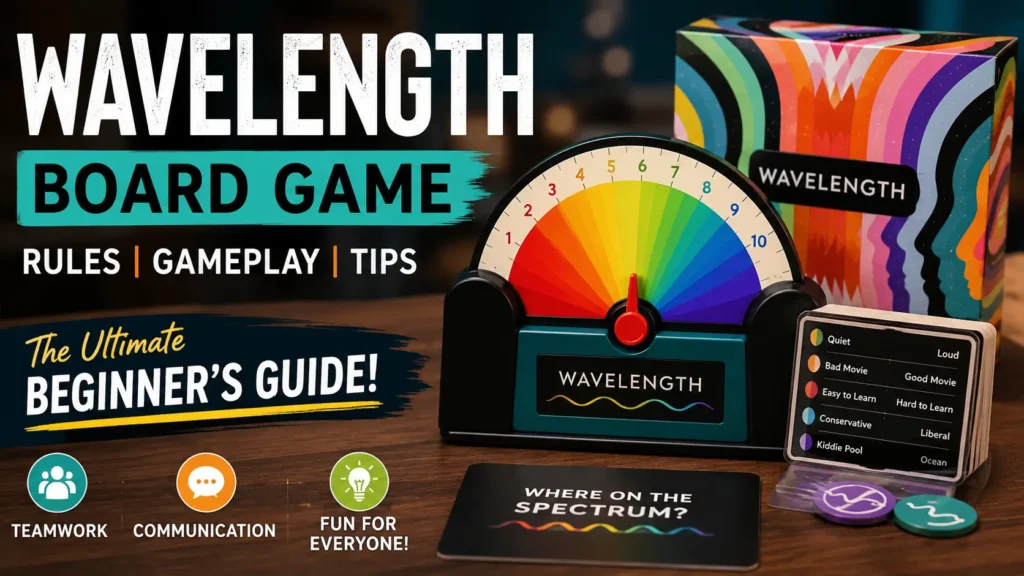
Instead of answering factual questions, participants interpret subjective ideas. For example, a spectrum might range from “Hot” to “Cold,” “Easy to Learn” to “Hard to Learn,” or “Good Movie” to “Bad Movie.” The clue giver knows the hidden target location and provides a clue to help teammates guess where it lies.
The game stands out because success depends on shared perspectives rather than knowledge or memorization.
Why the Wavelength Board Game Is So Popular
Modern board game enthusiasts often praise Wavelength because it is easy to learn yet highly engaging.
Some reasons for its popularity include:
- Fast setup and simple rules
- Suitable for large groups
- Encourages conversation and laughter
- Works well with friends, families, and coworkers
- Creates unique gameplay every session
- Appeals to both casual and experienced gamers
Because every clue sparks discussion, no two games feel the same.
Wavelength Board Game Components
The physical game includes several key components that drive gameplay.
| Component | Purpose |
| Wavelength Device | Houses the hidden target zone |
| Spectrum Cards | Provide different scales and categories |
| Scoring Track | Tracks team progress |
| Guessing Dial | Used to indicate the team’s final guess |
| Tokens | Used for scoring and game management |
The centerpiece is the rotating device that conceals the target location while displaying only the visible spectrum.
Wavelength Board Game Rules Explained
Understanding the wavelength board game rules is surprisingly simple.
Step 1: Divide Into Teams
Players split into two teams. Each team takes turns selecting a clue giver.
Step 2: Reveal a Spectrum
A spectrum card is selected and displayed. Examples include:
- Quiet ↔ Loud
- Dangerous ↔ Safe
- Useful ↔ Useless
- Fancy ↔ Casual
The spectrum determines the scale on which the hidden target exists.
Step 3: Set the Secret Target
The clue giver secretly views the target location inside the Wavelength device.
Only the clue giver knows where the target lies.
Step 4: Give a Clue
The clue giver provides a single clue that represents the target position.
For example:
Spectrum: “Hot ↔ Cold”
Target: Very close to Hot
Possible clue: “Volcano”
The clue should help teammates understand the intended position on the spectrum.
Step 5: Team Discussion
Teammates discuss where they believe the clue fits on the scale.
This is often the most entertaining part of the game.
Step 6: Make a Guess
The team rotates the dial to indicate their chosen position.
Step 7: Reveal and Score
The hidden target is revealed.
Points are awarded based on how accurately the team identified the target zone.
The closer the guess, the more points earned.
How Scoring Works
Scoring rewards for accuracy.
| Guess Accuracy | Typical Result |
| Direct Hit | Maximum points |
| Close Guess | Moderate points |
| Near Miss | Minimal points |
| Far Away | No points |
Teams continue alternating turns until one team reaches the winning score.
Example Round of Wavelength
Imagine the spectrum is:
Cheap ↔ Expensive
The hidden target sits approximately 80% toward Expensive.
The clue giver says:
“Private Jet”
Team members discuss where a private jet belongs on the scale. Since most people associate private jets with luxury and high cost, the team places its marker near the expensive end.
When the target is revealed, they discover they were very close and earn valuable points.
This simple interaction demonstrates how the game relies on shared understanding.
Best Strategies for Beginners
New players often improve quickly by following a few key strategies.
Think About Shared Knowledge
Choose clues that most teammates will interpret similarly.
A clue that is too personal may create confusion.
Avoid Overthinking
Many players try to create overly clever clues.
Simple clues often work best because they reduce ambiguity.
Consider the Entire Spectrum
A clue should communicate not only the category but also the specific position.
For example, “Coffee” may indicate warmth, but “Boiling Water” provides a stronger signal.
Listen During Discussions
Team conversations reveal how people interpret concepts.
Learning these patterns can improve future rounds.
Balance Specificity and Flexibility
The strongest clues guide teammates toward the target without being overly complicated.
Common Mistakes Players Make
Many first-time players encounter similar challenges.
Giving Vague Clues
Unclear clues can lead teammates in different directions.
Ignoring Team Perspectives
What seems obvious to one person may not be obvious to others.
Focusing on Personal Logic
Wavelength rewards shared understanding rather than individual reasoning.
Choosing Extremely Niche References
Obscure references may confuse teammates who lack the same background knowledge.
Is Wavelength a Good Party Board Game?
Absolutely.
As a party board game, Wavelength succeeds because it encourages participation from everyone at the table.
Unlike games that eliminate players or require specialized knowledge, Wavelength keeps every participant engaged. Discussions often become humorous as players debate the meaning of clues and compare viewpoints.
This makes it ideal for:
- Family gatherings
- Game nights
- Office team-building events
- College groups
- Holiday parties
The game’s accessibility is one of its greatest strengths.
Wavelength vs Traditional Party Games
| Feature | Wavelength | Traditional Trivia Games |
| Requires Knowledge | No | Often Yes |
| Team Communication | High | Moderate |
| Replayability | Excellent | Good |
| Learning Curve | Easy | Easy |
| Creativity | High | Low to Moderate |
| Discussion | Extensive | Limited |
Players who enjoy social interaction often prefer Wavelength because communication drives the experience.
Who Should Play Wavelength?
Wavelength is suitable for a wide variety of players.
Casual Gamers
The rules can be learned within minutes.
Board Game Enthusiasts
The game offers surprising depth despite its simplicity.
Families
The gameplay encourages conversation across age groups.
Professionals and Teams
Many organizations use Wavelength as an icebreaker or team-building exercise because it highlights communication styles and collaborative thinking.
FAQ About Wavelength Board Game
What is the objective of the Wavelength Board Game?
The goal is to help your team identify the hidden target position on a spectrum using carefully chosen clues and discussion.
How many players can play Wavelength?
Wavelength works best with 4–12 players, though larger groups can also participate by forming teams.
Are the wavelength board game rules difficult to learn?
No. Most players understand the core rules within a few minutes, making it highly beginner-friendly.
How long does a game of Wavelength take?
A typical session lasts between 30 and 60 minutes, depending on group size and scoring preferences.
Is Wavelength suitable for families?
Yes. Families often enjoy the game’s conversational nature and simple mechanics.
Can children play Wavelength?
Older children and teenagers can usually play comfortably, especially when using age-appropriate clues and discussions.
Is Wavelength a competitive game?
It includes competition between teams, but the primary focus is communication and shared understanding.
Why is Wavelength considered a great party board game?
It encourages interaction, discussion, laughter, and participation from everyone involved, making it ideal for social gatherings.
Does Wavelength require a strategy?
Yes. While easy to learn, successful teams develop strategies for clue selection, communication, and interpreting perspectives.
Is Wavelength worth buying for game nights?
Many players consider it one of the most replayable social board games because every group generates unique discussions and experiences.
Conclusion
The Wavelength Board Game combines creativity, communication, and teamwork in a way few games can match. Its simple rules make it accessible to beginners, while its emphasis on understanding how others think keeps experienced players engaged. Whether you’re organizing a casual game night, a family gathering, or a professional team-building event, Wavelength offers memorable interactions and endless replayability. By understanding the rules, practicing effective clue-giving, and embracing group discussion, you’ll quickly discover why this modern party game has become a favorite among players around the world.