
The Wavelength Game for 2 Players proves that this award-winning party favorite does not need a crowd to shine. Built around reading your partner’s mind on a hidden spectrum.
Wavelength officially supports two people through a clever cooperative mode, and many fans consider it the best way to experience the game. Whether you are planning a date night, a quiet evening with a friend, or a fun mental workout, this guide covers everything: setup, official rules, scoring, smart variants, and expert tips. By the end, you will know exactly how to play Wavelength with two people and score higher together.
What Is Wavelength? A Quick Overview
Wavelength is a social guessing game designed by Alex Hague, Justin Vickers, and Wolfgang Warsch, published in 2019 by CMYK (originally Palm Court). It supports 2 to 12 players, ages 14 and up, runs 30 to 45 minutes, and won the Golden Geek Best Party Game award the year it launched.
The heart of the game is a circular device with a rotating dial and a hidden target. One player, the Psychic, secretly views where the target sits on a spectrum between two opposite concepts, such as Hot–Cold or Underrated–Overrated. The Psychic gives a single clue, and the guesser turns the dial toward where the target seems to hide. The closer the guess, the more points you score.
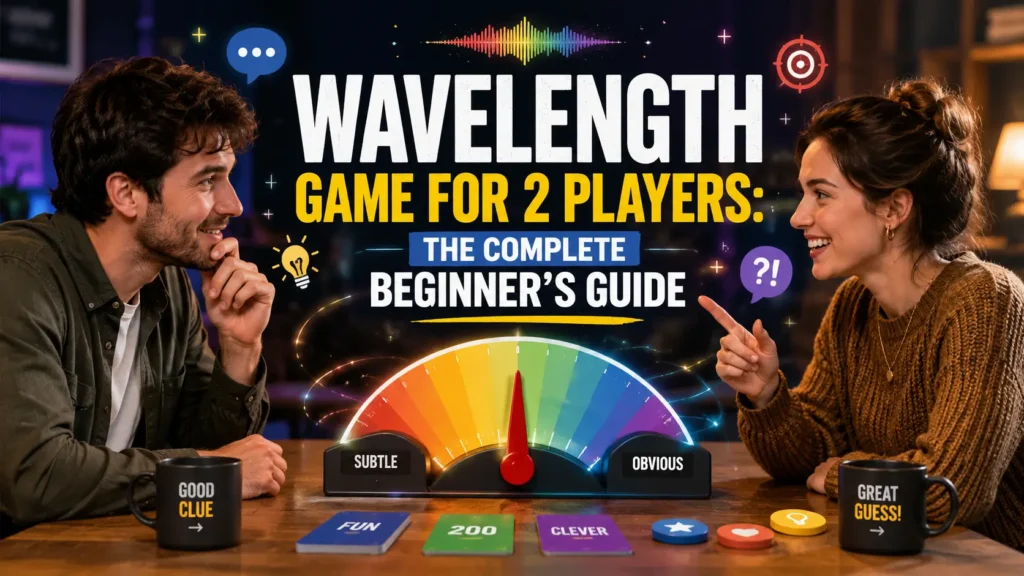
Can You Play Wavelength with Only 2 Players?
Yes. Wavelength includes an official cooperative mode printed right in the rulebook, and it works beautifully with exactly two people. Instead of two teams competing, you and your partner join forces, take turns giving clues, and chase the highest combined score across seven rounds. No house rules are needed, which is why so many couples and roommates treat it as their go-to two-player party game.
What You Need Before You Start
Everything required for a two-player session comes in the standard box:
- The Wavelength device with its rotating dial and sliding screen
- 84 double-sided spectrum cards, plus 42 advanced cards for experienced duos
- One scoring token to track your shared points
- A flat surface and about half an hour of free time
The left/right guess token stays in the box, since co-op play skips that phase entirely.
How to Play Wavelength with Two People: Step-by-Step
The cooperative rules follow a simple rhythm. Here is a full round from start to finish.
Step 1: Build Your Seven-Card Deck
Shuffle the spectrum cards and randomly select seven. Place them in the card slot on the tray. These seven cards set the length of your game, although strong play can extend it.
Step 2: The Psychic Sets the Target
One player becomes the Psychic. With the screen closed, they draw the top card, read both concepts aloud, and spin the wheel to randomize the target. They then peek behind the screen and think of a single clue that sits at exactly that point on the spectrum.
Step 3: Give One Clue, Then Stay Silent
The Psychic announces the clue, closes the screen, and turns the device toward their partner. From this moment, the Psychic cannot speak, gesture, or react until the guess is locked in. Clues must express one idea, stay on topic, avoid any words printed on the card, and never include numbers or percentages.
Step 4: Your Partner Turns the Dial
The guessing player weighs the clue, rotates the dial to the spot that feels right, and confirms the final position. Thinking out loud is allowed and usually half the fun.
Step 5: Reveal and Score
The Psychic opens the screen, both players see the target, and points are recorded. Swap roles, draw the next card, and continue until the deck runs out.
Scoring in 2-Player Cooperative Mode
Scoring mostly mirrors the standard game, with one twist. Outer target wedges earn two or three points. The center bullseye earns three points instead of four, but lets you add a bonus card to the deck, granting an extra round and a higher ceiling.
When the final card is played, compare your total against the rulebook’s rating chart:
| Final Score | What It Means |
|---|---|
| 0–9 | A rough session; recalibrate and try again |
| 10–15 | Solid progress, just short of victory |
| 16–18 | An official win |
| 19–24 | Genuinely impressive sync |
| 25+ | Rare, elite territory |
A Competitive Variant for Head-to-Head Play
Prefer a clear winner? Try this popular unofficial variant. Play seven rounds each, alternating the Psychic role, and track two separate scores. Keep the bullseye worth four points, skip bonus cards, and drop the left/right phase, which needs an opposing team. Whoever earns more points across their clue-giving rounds wins. It is a fun change of pace, though most pairs find the cooperative mode more satisfying.
Tips to Score Higher as a Duo
A two-player game rewards deep familiarity. These habits raise scores fast:
- Lean on shared references, such as movies you have both seen, since they calibrate better than generic clues.
- Give the obvious clue, not the clever one. Ambiguity is your enemy with a single guesser.
- Debrief after every reveal. A quick “why did you pick that?” builds the mental model that wins games.
- Chase bullseyes when confident, since the bonus card extends the game and lifts your ceiling.
- Respect the direction of the spectrum. A clue leaning toward the wrong side wastes the whole round.
Common Mistakes Beginners Make
- Padding clues with modifiers like “slightly” or “kind of,” which the rulebook discourages
- Sneaking numbers or percentages into clues, which breaks an official rule
- Choosing obscure references a partner cannot place
- Forgetting to add the bonus card after a bullseye
- Giving up early, even though seven rounds leave room for comebacks
Two Players vs. a Full Group: What Changes?
Feature2-Player Co-opFull-Group Competitive
Objective: Beat your best shared score. First team to 10 points
Bullseye value 3 points plus a bonus round 4 points
Left/right phase Skipped Included
Game length 7 or more rounds Varies by score pace
Atmosphere: Focused and intimate Loud and debate-driven
The two-player format trades noisy group arguments for quiet precision. Many players find the smaller table sharpens the core mind-reading challenge rather than diluting it.
Frequently Asked Questions
Is the Wavelength game for 2 players actually fun, or a compromise?
It is genuinely fun. The cooperative mode was built for small counts, and many owners prefer it because every round tests how well two specific people understand each other.
How many rounds does a two-player game last?
The game starts with seven cards, so seven rounds minimum. Every bullseye adds a bonus card, so well-synced pairs often play eight to ten rounds.
What is a good score in cooperative Wavelength?
Sixteen points or more counts as an official win under the rulebook’s chart. Anything above 19 signals unusual sync, and 25 or more is elite.
Do two players use the left/right guessing phase?
No. That phase exists for an opposing team, so the cooperative rules remove it, which also keeps the pace quick.
How long does a two-player session take?
Most duos finish in roughly 20 to 30 minutes, slightly faster than the 30 to 45 minutes typical of large groups.
Can the Psychic clarify a clue after giving it?
No. Once the clue is spoken, the Psychic must stay silent until the dial is locked. Extra hints undermine the core challenge.
Are numbers allowed in clues?
No. Numbers, percentages, and ratios are banned because they would describe the dial position directly. Numbers inside proper names, such as a film title, are fine.
Is there a digital way to play with two people?
Yes. A free official Wavelength app on iOS and Android makes it easy to play Wavelength with two people anywhere, with scoring handled automatically.
What age is Wavelength suitable for?
The publisher recommends ages 14 and up, largely due to cultural references. Younger players do fine with simpler spectrum cards.
How can experienced pairs raise the difficulty?
Mix in the 42 advanced cards, restrict clues to a single word, or set a personal target of 22 points instead of the standard win line.
Final Thoughts
Wavelength earns its reputation as a brilliant group game, but its two-player cooperative mode is far more than an afterthought. It strips away the noise and turns each round into a pure test of shared understanding, the very thing that makes the game special. Set up the seven-card deck, take turns as the Psychic, and watch your scores climb as your calibration improves. For date nights, quiet evenings, and friendly rivalries alike, the Wavelength game for 2 players delivers one of the most rewarding small-count experiences on any shelf.