
Wavelength Game Player Count is the first detail most people check before bringing this award-winning party game to the table. Officially, Wavelength supports 2 to 12 players, yet the experience shifts noticeably depending on group size. A packed party night feels completely different from a two-player session, and understanding that difference helps you plan better game nights. In this beginner-friendly guide, you will learn the official player range, how the game feels at every group size, the ideal sweet spot for competitive play, and simple tips for scaling. By the end, you will know exactly how many players Wavelength needs.
What Is Wavelength? A Quick Overview
Wavelength is a social guessing game designed by Alex Hague, Justin Vickers, and Wolfgang Warsch, published by CMYK (originally Palm Court) in 2019. Each round, one player becomes the Psychic. The Psychic secretly sees a target hidden on a dial, then gives a single clue based on a spectrum card such as “Hot – Cold” or “Underrated – Overrated.” Teammates rotate the dial to where they believe the target sits, and points are awarded for accuracy.
The rules take about a minute to learn, which is why the game works so well for casual groups. What truly shapes the experience, though, is how many people are sitting around the table.
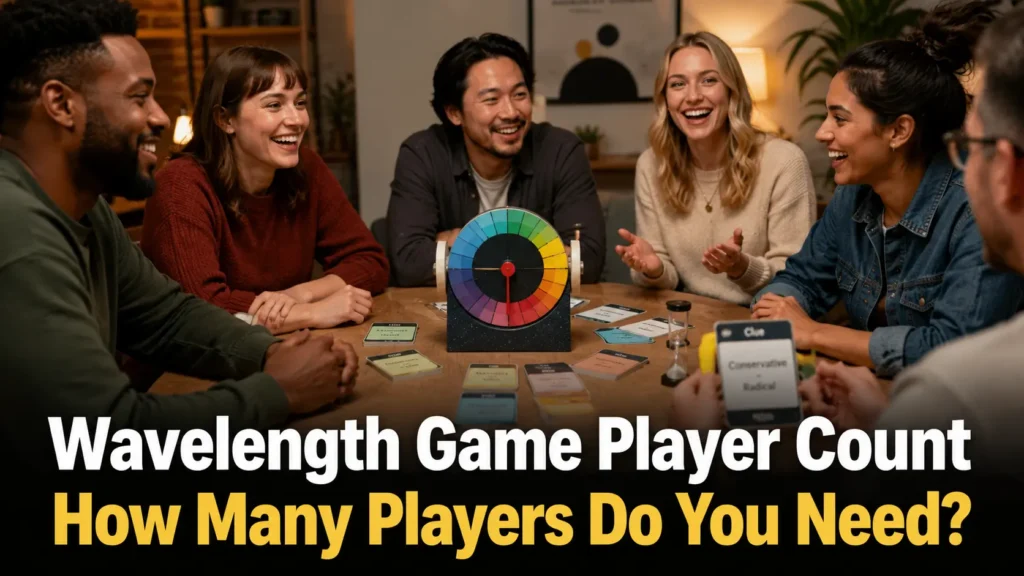
Wavelength Game Player Count: The Official Answer
The official Wavelength game player count is 2 to 12 players. The standard game is a competition between two teams, while an official cooperative mode included in the rulebook covers smaller groups.
Here are the key numbers at a glance:
- Minimum players: 2 (using the cooperative mode)
- Maximum official players: 12
- Standard format: two competing teams
- Recommended age: 14 and up
- Typical playtime: 30 to 45 minutes
One helpful detail for planners: teams do not need to be equal in size. A group of seven can comfortably split into teams of three and four, because scoring rewards guessing accuracy rather than headcount.
How Wavelength Plays at Every Group Size
Player count changes the personality of Wavelength more than almost any other party game. Here is what to expect at each range.
2 to 3 Players: The Cooperative Experience
With only two or three people, competitive team play falls flat, so the rulebook offers a cooperative variant instead. Everyone works together, plays through a set stack of seven spectrum cards, skips the left-or-right guessing phase, and measures success against a score chart at the end.
This version feels calm and conversational. It is ideal for couples, close friends, or anyone learning the game before introducing it to a bigger group. The trade-off is that you lose the team rivalry that fuels the loudest moments.
4 to 6 Players: The Competitive Sweet Spot Begins
Four players is the minimum for proper two-team competition, and the game immediately gains energy. Teams of two or three keep every discussion tight, turns come around quickly, and each player often takes the Psychic role.
This range suits regular game nights where people want meaningful participation. Clue-giving feels personal, and no one fades into the background.
7 to 12 Players: Full Party Mode
Large groups turn Wavelength into a genuine event. Debates get louder, guesses become collective negotiations, and each hidden-target reveal lands like a game-show moment. Individual Psychic turns come less often, but watching a big team argue over where pizza belongs on a “Guilty pleasure – Actual pleasure” spectrum is entertainment in itself.
For groups this size, pacing matters. A gentle time limit on discussion prevents the game from stretching well past its usual length.
Wavelength Player Count at a Glance
| Player Count | Recommended Mode | Group Feel | Best Setting |
|---|---|---|---|
| 2–3 | Cooperative | Calm and thoughtful | Date nights, small hangouts |
| 4–6 | Two small teams | Focused and competitive | Regular game nights |
| 7–12 | Two large teams | Loud and social | Parties and gatherings |
| 12+ | Oversized teams (house rule) | Chaotic and hilarious | Big events and offsites |
What Is the Best Player Count for Wavelength?
Most experienced players and community ratings point to six to eight players as the ideal range. That size produces two teams of three or four — enough perspectives to spark real debate, yet small enough that every voice matters and turns stay frequent.
That said, “best” depends on what you want from the evening. If you value strategy and participation, aim for four to six. If you want maximum laughter and social energy, push toward eight or more. The game’s biggest strength is that it delivers a genuinely good session across the entire range, which is rare among party games.
Tips for Scaling Wavelength Up or Down
A few practical adjustments help the game shine at any table size:
- With 2–3 players, use the cooperative mode and try to beat your previous group score. Turning it into a personal challenge keeps replays fresh.
- With uneven numbers, split experienced players across both teams instead of worrying about matching headcounts.
- With large teams, ask everyone to state an opinion before the dial locks in, so quieter players are heard.
- Beyond 12 players, simply build bigger teams. The official cap is 12, but the game scales socially far past it, and many groups happily play with 14 or more.
- For remote groups, the official free Wavelength app supports 2 to 10 or more players across devices, making distance a non-issue.
Common Mistakes to Avoid
New groups often assume they need an even number of players, or they skip the cooperative rules entirely and force an awkward one-versus-one match. Both are unnecessary. Another frequent misstep is letting one confident voice dominate large-team discussions, which drains the fun for everyone else. Finally, avoid overthinking clues; the best rounds come from quick, instinctive answers rather than five minutes of deliberation.
Frequently Asked Questions
How many players do you need for Wavelength?
You need at least two players. The full Wavelength game player count runs from 2 to 12, with cooperative rules covering small groups and team play covering everyone else.
Can you play Wavelength with 2 players?
Yes. Two players use the official cooperative mode, working together through seven spectrum cards and comparing their final score against the rulebook’s rating chart.
What is the best number of players for Wavelength?
Six to eight players is widely considered the sweet spot. It creates two lively teams while keeping Psychic turns frequent for everyone at the table.
Can you play Wavelength with more than 12 players?
Officially, 12 is the maximum. In practice, larger parties simply form bigger teams, and the game still works because scoring never depends on team size.
Do teams in Wavelength need to be even?
No. Uneven teams are completely fine. Balance experience levels across both sides instead of worrying about matching numbers.
Does Wavelength have a cooperative mode?
Yes. The cooperative variant is printed in the base game’s rulebook and is the recommended way to play with two or three people.
How long does a game of Wavelength take?
Most sessions last 30 to 45 minutes. Larger groups may run longer because discussions expand, so a light time limit helps keep things moving.
What age is Wavelength recommended for?
The publisher recommends ages 14 and up, mainly because some spectrum concepts are abstract. Younger players can join if you pre-select simpler cards.
Is there a digital version of Wavelength?
Yes. An official free app supports 2 to 10 or more players on mobile devices and works for both in-person and remote play.
Does the Wavelength game player count affect difficulty?
Not directly. Difficulty comes from the spectrum cards and the clues, though larger teams often guess more accurately because more perspectives get shared.
Final Thoughts
The Wavelength game player count — officially 2 to 12 — is one of the main reasons this title has become a modern party classic. Few games handle a quiet evening for two and a twelve-person gathering with equal confidence. Small groups get a thoughtful cooperative puzzle, mid-sized groups get sharp team competition, and big crowds get pure social energy. Whatever number shows up to your game night, Wavelength has a mode that fits, so set up the dial, pick your first Psychic, and find out who is truly on your wavelength.