
Wavelength game FAQ gives beginners clear answers about this free online guessing game, including its rules, play time, player count, scoring, clue creation, and the easiest way to start playing.
What Is the Wavelength Game?
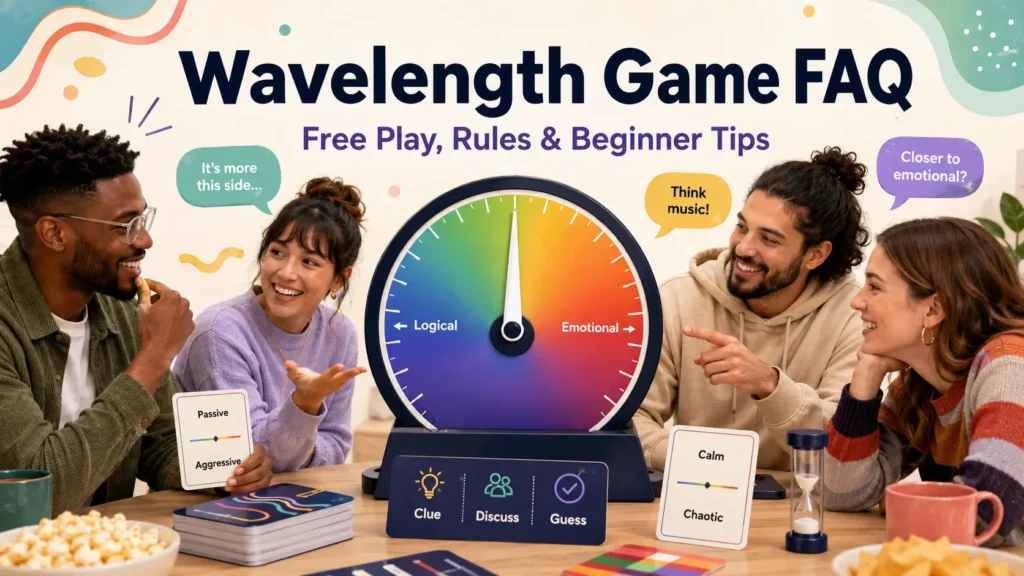
Wavelength is a social guessing game in which players try to understand how another person thinks. Each round presents two opposite ideas, and players must decide where a given clue belongs between them.
For example, the scale might run from “boring” to “exciting.” A clue giver could say “a surprise birthday party,” and the other players would discuss how close that clue should be placed to the exciting side.
The game is based on opinions rather than fixed facts. That means different players can interpret the same clue in completely different ways, creating interesting conversations and humorous disagreements.
Is Wavelength Free to Play?
Yes, Wavelength is free to play on this website. Players can access the game without purchasing a physical board game, paying a membership fee, or unlocking a premium package.
Free access makes it suitable for casual players who want to enjoy a quick social game with friends, relatives, classmates, or coworkers. New players can explore the format and understand the rules without making any financial commitment.
The game is designed to be accessible, so people do not need advanced gaming knowledge. Its main requirements are communication, imagination, and a willingness to understand other viewpoints.
How Does the Wavelength Game Work?
Each round begins with a scale containing two opposite concepts. One player acts as the clue giver and receives or selects a hidden target somewhere between those two extremes.
The clue giver must think of something that represents the target’s approximate position. The remaining players listen to the clue, share their opinions, and choose where they believe it belongs on the scale.
After the group confirms its position, the target is revealed. Players receive a better result when their chosen position is close to the hidden target.
Basic Round Structure
A standard Wavelength round normally follows these steps:
- Two opposite ideas appear on the scale.
- One participant becomes the clue giver.
- The clue giver studies the hidden target.
- A relevant word, person, object, place, or situation is given as a clue.
- Other players discuss the clue’s likely position.
- The group confirms its final answer.
- The hidden target is revealed.
- Points are awarded according to accuracy.
The process is easy to understand after one practice round. Most of the entertainment comes from the discussion that happens before the final answer is selected.
How Long Is Wavelength?
People searching “how long is Wavelength” can expect a typical session to last approximately 20 to 45 minutes. The actual duration depends on the number of rounds, group size, and how long players discuss each clue.
A small group that makes quick decisions may complete a session in about 15 to 25 minutes. A larger group can take longer because more participants may want to explain their interpretation.
First-time players should reserve around 30 minutes. This provides enough time to understand the game, complete several rounds, and enjoy the conversation without feeling rushed.
How Many Players Can Join?
Wavelength can work with two players, but it becomes more interactive when several people participate. A group of four to eight players usually creates a good balance between active discussion and manageable decision-making.
Larger groups can divide into teams. Team members can discuss each clue together before one person confirms the final position on behalf of the group.
For very large groups, setting a short discussion limit can keep the game moving. It also gives quieter participants a fair opportunity to share their opinions.
Can Two People Play Wavelength?
Yes, Wavelength can be played by two people. One player gives a clue while the other tries to place it correctly on the scale. The players can exchange roles after every round.
Two participants can compete by tracking individual points or play cooperatively by trying to achieve the highest combined score.
Although a two-player session contains less group debate, it can still be entertaining. It works especially well for friends, couples, siblings, or coworkers who want to test how accurately they understand each other.
What Are the Main Wavelength Rules?
The clue must relate naturally to the two opposite concepts shown during the round. It should guide the players toward the target without directly revealing its exact location.
Once the clue has been given, the clue giver should avoid providing additional explanations. Reactions, facial expressions, gestures, or corrections can accidentally influence the group’s decision.
Players should discuss the clue fairly and allow different opinions to be heard. The final answer should represent the group’s best shared judgment rather than one person controlling every round.
Rules for Giving Effective Clues
A useful clue should be clear enough to understand but open enough to create discussion. It should not describe the target through exact percentages, measurements, or direct positional instructions.
For example, saying “place it 70 percent toward exciting” removes the guessing element. Saying “going on your first international trip” gives players something meaningful to interpret.
Clue givers should also avoid references that only one group member understands. Familiar examples usually produce more balanced and enjoyable rounds.
How Does Wavelength Scoring Work?
Players earn stronger results when their selected position lands close to the hidden target. A highly accurate guess receives more points, while a distant answer may receive fewer points or none.
The scoring system rewards understanding rather than speed. Players do not need to make instant decisions, but discussions should remain focused so each round does not become unnecessarily long.
Groups can use the standard scoring format included in the game or create a simple custom system. Casual players may prefer completing a fixed number of rounds and comparing total scores at the end.
What Makes a Good Wavelength Clue?
A strong clue connects naturally with both ends of the scale. It should be familiar to the group and specific enough to point toward a general position.
Consider a scale from “ordinary” to “luxurious.” The clue “a hotel breakfast” could create confusion because hotel experiences vary widely. A more specific clue, such as “breakfast delivered to a private hotel suite,” gives players a clearer idea.
However, clues should not become long descriptions. A short and recognizable clue usually creates better discussion than a detailed explanation containing multiple hints.
Beginner Tips for Better Gameplay
New players should begin with simple scales and familiar clues. Everyday subjects such as food, movies, school, travel, technology, or common activities are easier to discuss than highly technical topics.
Players should also remember that Wavelength is not about discovering one universal truth. The goal is to predict how the clue giver personally views the clue.
Useful beginner practices include:
- Allowing every player to share an opinion
- Keeping clues short and understandable
- Avoiding exact numerical hints
- Choosing references familiar to the group
- Setting a reasonable discussion limit
- Rotating the clue-giver role regularly
- Focusing on enjoyment rather than perfect accuracy
The group should treat disagreements as part of the game. Different interpretations often create the funniest and most memorable moments.
Common Mistakes to Avoid
One common mistake is giving a clue that has no clear relationship with the scale. When players cannot understand why a clue was selected, they are forced to guess randomly.
Another mistake is overexplaining. The clue giver may unintentionally reveal the answer by adding details after hearing the group’s discussion.
Players may also spend too long searching for a perfect position. Wavelength works best when participants explain their reasoning, reach a reasonable decision, and move to the reveal.
Why Is Wavelength Good for Groups?
Wavelength encourages players to listen, explain ideas, and consider perspectives different from their own. These skills make it more than a basic guessing activity.
Friends and families can use the game for relaxed entertainment, while teachers may use it to encourage classroom participation. Professional teams can also use it as an informal communication or team-building activity.
Because the game is based on discussion, people with limited gaming experience can join comfortably. Fast reactions, advanced controls, and specialist knowledge are not required.
Wavelength Game FAQ
Is Wavelength free?
Yes, the Wavelength game available on this website is completely free to play. Players do not need to purchase a subscription or unlock paid gameplay features.
How long is Wavelength?
A typical game takes around 20 to 45 minutes. The duration can change depending on the number of players, rounds, and discussion time.
Is Wavelength difficult for beginners?
No. The basic rules are easy to understand, and most beginners can start playing confidently after completing one example round.
Can Wavelength be played with two players?
Yes. Two players can alternate between giving clues and selecting positions. They can compete individually or work toward a shared score.
What is the best number of Wavelength players?
Four to eight players often provides the most balanced experience. This group size creates lively discussion without making each round difficult to manage.
Can children play Wavelength?
Children can play when they understand the words and concepts used on the scales. Adults can choose simpler topics when playing with younger participants.
Is Wavelength a trivia game?
No. Wavelength focuses on opinions, interpretation, and shared understanding. Players do not need to memorize facts or answer traditional trivia questions.
Can Wavelength be used for team building?
Yes. The game encourages communication, listening, compromise, and perspective-taking, making it suitable for relaxed workplace team-building sessions.
What type of clue should players give?
Players should give a short, familiar clue that relates clearly to the scale. It should provide direction without revealing the target’s exact position.
Can players use numbers in their clues?
Players should avoid using percentages or numbers as direct positional hints. These clues can make the target too obvious and reduce the challenge.
Why do players have different answers?
Each person understands ideas through individual preferences and experiences. These differences naturally lead players to place the same clue in different positions.
Can Wavelength be played remotely?
Yes. Players can discuss clues through a voice or video call while one participant manages the game and confirms the group’s selected position.
Does Wavelength require gaming experience?
No gaming experience is necessary. Anyone who can understand the scale, discuss a clue, and choose a position can participate.
How can players make rounds faster?
Set a short discussion limit, let each participant explain their opinion once, and allow one selected player to confirm the final answer.
Conclusion
Wavelength is a free, social guessing game that turns simple clues into lively discussions, creative decisions, and memorable group entertainment.