
Understanding the Wavelength clue rules is the difference between a clue that lands dead-center and one that leaves your team guessing wildly. Wavelength is a social party game built on intuition, where one player nudges teammates toward a hidden point on a spectrum using a single, well-chosen hint. But that hint has to follow a few important boundaries. This guide breaks down exactly what makes a clue legal, what gets you in trouble, and how to phrase hints that reliably score. Whether you’re playing your first round or sharpening your strategy, you’ll leave knowing how to give clues with confidence.
What Is Wavelength and Why Clues Matter
Wavelength is a team-based guessing game built around a hidden dial. Each round, one player becomes the Psychic. They spin a wheel to randomly place a hidden target somewhere on a spectrum, then secretly peek at where it landed.
That spectrum sits between two opposing ideas printed on a card, such as Hot – Cold, Underrated – Overrated, or Round – Pointy. The whole dial represents the range between those two extremes.
The Psychic’s job is simple to describe but tricky to master: give a single clue that points teammates toward the hidden target. The team then rotates the dial to where they think the target sits. Because the scoring zone is narrow, the quality of your clue decides almost everything. A vague hint scatters guesses; a precise one earns full points.
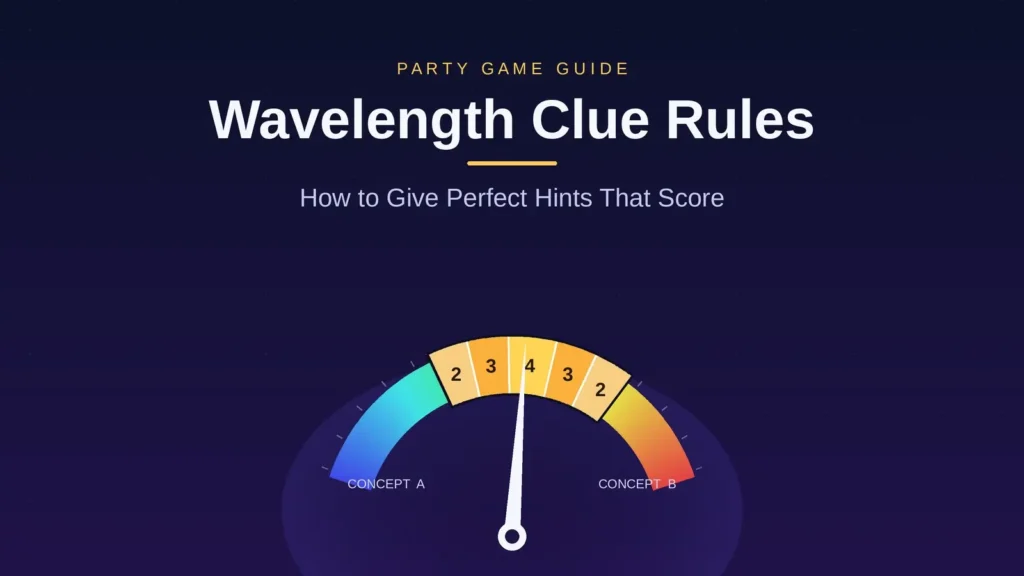
How the Spectrum and Scoring Work
Before diving into the rules, it helps to understand what you’re aiming for. The hidden target is divided into colored wedges, each worth a different number of points depending on how close the dial lands to the center.
| Where the dial lands | Points scored |
| Dead-center wedge | 4 points |
| Either wedge beside the center | 3 points |
| Outer edges of the target | 2 points |
| Outside the target entirely | 0 points |
There’s also a clever twist for the team that isn’t guessing. After the Psychic’s team locks in the dial, the opposing team predicts whether the true target is to the left or right of that guess. If they’re correct, they earn a bonus point. This keeps everyone engaged, even between turns.
Most games are played to 10 points, and a fresh player takes the Psychic role each round so the clue-giving spreads around the table.
The Core Wavelength Clue Rules
This is the heart of the game. A clue only works if it follows the official boundaries. Break them, and your hint stops being clever and starts being unfair. Here are the essential Wavelength clue rules every player should know.
- Keep it to a single thought. Your clue should express one clear idea, not a bundle of stacked concepts. “Coffee” works; “coffee, but the kind you drink in winter near a fire” does not.
- It must exist in the real world. Clues have to reference something real. Invented words, made-up creatures, or imaginary objects aren’t allowed because teammates can’t reason about them.
- Stay on the spectrum. The clue has to relate directly to the two concepts on the card. A clue unrelated to the spectrum gives your team nothing useful.
- No double meanings or wordplay. Puns, riddles, and clues with two interpretations are off-limits. The goal is honest placement, not trickery.
- Avoid words on the card. You can’t use either printed concept, and you also can’t sneak in synonyms or rhymes of those words.
- No numbers. You can’t say “seven out of ten” or describe the dial’s position numerically. The clue must be conceptual, not a coordinate.
A good mental test: would a thoughtful teammate be able to picture your clue and place it somewhere meaningful on the spectrum? If yes, you’re on the right track.
Clue Examples That Bring the Rules to Life
Rules click faster with examples. Imagine the card reads “Hot – Cold,” and you can see roughly where the hidden target is. Here’s how strong clues map onto different positions.
| Target position | Possible clue | Why it works |
| Far “Hot” end | Lava | An extreme that anchors the very edge |
| Slightly toward “Hot” | Coffee | Warm, but not the hottest thing imaginable |
| Right in the middle | Room temperature water | A neutral, balanced reference |
| Slightly toward “Cold” | A swimming pool | Cool but not freezing |
| Far “Cold” end | Antarctica | An unmistakable extreme |
Notice how each clue is a single, real-world thing that naturally lives at a specific spot between hot and cold. That’s the skill the game rewards. You’re translating a position into an image your teammates can feel.
How to Give Sharper Wavelength Hints
Knowing the rules is step one. Giving hints that consistently score is step two. These habits separate casual players from reliable point-earners.
- Aim for the center, not the edge. Picture the exact spot, then choose a clue that sits there precisely rather than “somewhere in that area.”
- Think about your specific teammates. A clue’s meaning depends on shared knowledge. A movie reference only helps if your team has seen the film.
- Avoid weak modifiers. Hedging words like “kind of,” “slightly,” or “very” muddy the signal. A confident, concrete clue communicates far more.
- Use proper nouns when they fit. A specific person, place, or brand can pin a position more sharply than a general category.
- Commit and stay silent. Once you give the clue, resist the urge to react. The rules ask the Psychic to stay quiet and expressionless while the team debates.
Common Clue Mistakes to Avoid
Even experienced players slip into a few traps. Watching for these will instantly raise your scoring.
The most frequent mistake is overthinking. Players reach for obscure references that feel clever but leave teammates lost. Simpler clues usually score higher because they’re easier to place.
Another common error is choosing an extreme clue for a target that’s only somewhat toward one side. If the target leans gently toward “Hot,” a clue like “the surface of the sun” will drag the dial too far.
Finally, some players accidentally break the rules by smuggling in two ideas or hinting at numbers. Keep each clue clean, singular, and conceptual, and you’ll stay on the right side of the Wavelength clue rules every time.
Frequently Asked Questions
What are the Wavelength clue rules in simple terms?
A clue must be a single real-world idea that fits on the spectrum, with no card words, synonyms, rhymes, numbers, or double meanings. One clear thought, honestly placed.
Can a Wavelength clue be more than one word?
Yes. Clues are often a short phrase rather than a single word. The key limit is that it should express one unified idea, not several stacked concepts.
Are numbers allowed as clues?
No. You can’t use numbers to describe the target’s position or strength. Clues have to be conceptual, so teammates reason through meaning rather than a coordinate.
Can I use words printed on the spectrum card?
No. The two concepts on the card are off-limits, and so are their synonyms and rhymes. This keeps clues from simply restating the spectrum itself.
What happens if a clue breaks the rules?
Most groups simply ask the Psychic to give a new clue. Wavelength is a casual party game, so enforcement is friendly rather than strict, but the spirit of fair play matters.
How does scoring work in Wavelength?
The dial earns 4 points for the center wedge, 3 for the wedges beside it, and 2 for the outer edges. The opposing team can earn a bonus point for a correct left-or-right guess.
Why can’t clues have double meanings?
Double meanings turn the game into a riddle and undermine honest placement. The fun comes from genuine intuition, so the rules ask for clues with one clear interpretation.
Is “the Psychic” allowed to talk during guessing?
No. After delivering the clue, the Psychic should stay silent and avoid reactions. Letting body language leak hints would defeat the purpose of the clue rules.
What makes a good Wavelength clue?
A good clue is a single, real, well-known thing that naturally lives at the exact spot you’re targeting, phrased in a way your specific teammates will understand.
Can I give clue examples to new players?
Absolutely. Walking newcomers through a few clue examples, like “Coffee” on a Hot–Cold spectrum, is one of the fastest ways to teach the rules without overwhelming them.
Final Thoughts
At its core, Wavelength rewards a simple skill: turning a hidden position into a hint your team can feel. The clue rules exist to keep that challenge honest, fair, and genuinely fun. Stick to one real-world idea, stay on the spectrum, skip the numbers and wordplay, and aim straight for the center. Do that, and you’ll move from lucky guesses to clues that consistently land. The more you play, the more you’ll sense how your group thinks, and that shared instinct is exactly what makes a perfect clue feel so satisfying.