
The Wavelength Game Setup takes only a couple of minutes, yet knowing exactly how the pieces fit together makes your first play much smoother. In this popular party game, two teams try to read each other’s minds, guessing where a hidden target sits on a spectrum stretched between two opposite ideas, such as hot and cold.
Before the mind reading begins, though, you need to set up the device, place the markers, and divide everyone into two balanced teams. This beginner-friendly guide walks you through every step, explains the components, flags common mistakes, and answers the questions new players ask most often.
What Is Wavelength?
Wavelength is a social guessing game designed by Alex Hague, Justin Vickers, and Wolfgang Warsch, first published in 2019 by Palm Court, the studio now known as CMYK. Two teams compete to pinpoint a hidden target on a rotating wheel, guided only by a single clue that falls somewhere between two opposing concepts, such as “underrated” and “overrated.”
The box supports 2 to 12 players aged 14 and up, and most matches finish in 30 to 45 minutes. The rules are light, so a clean setup is all that stands between you and a great first round.
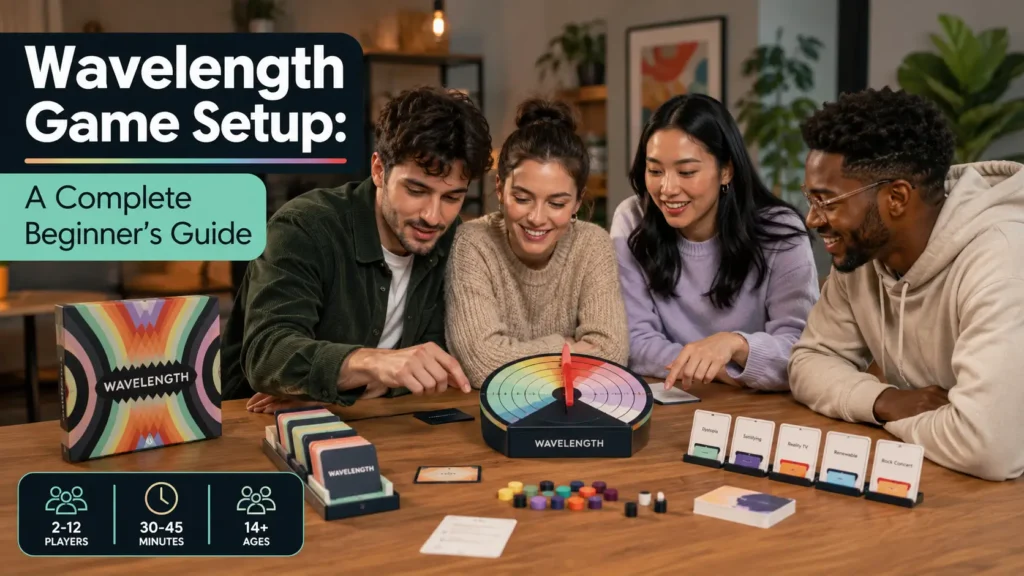
What Comes in the Box
Everything lives inside the box — the game is designed to be played without ever emptying the tray.
| The device | A rotating wheel that hides the scoring target behind a screen, topped with a red pointer dial |
| 84 wavelength cards | Double-sided prompts, each printed with a pair of opposite concepts |
| 2 score markers | Tokens that slide along the scoring track, one per team |
| 1 guessing marker | Records the opposing team’s left or right prediction each round |
| Plastic tray and rulebook | The tray holds every piece in place while you play |
The device is fully mechanical — no batteries, nothing to charge.
Wavelength Game Setup: Step-by-Step Instructions
The official setup takes about a minute once you know the sequence. Work through these five steps, and you are ready for the first clue.
Step 1: Seat the Device in the Box Tray
Open the box and leave the tray where it is. Press the device — the large plastic unit holding the wheel, screen, and red dial — into the central slot until it sits firmly. Playing inside the box keeps everything steady and lets you pass the whole game between teams without pieces sliding around.
Step 2: Place the Score and Guessing Markers
Slide the two team markers into the scoring track. Here is the detail new groups miss most often: the first team starts at zero, while the team going second starts at one point — a built-in balancing rule that offsets the advantage of moving first. Set the guessing marker in a slot beside the card holder for later rounds.
Step 3: Divide Players Into Two Teams
Split your group into two Wavelength teams of roughly equal size. The rulebook playfully calls them Left Brain and Right Brain, though any names will do. With an odd number of players, simply give one side an extra person — a one-player difference almost never decides a match.
Step 4: Choose Each Team’s First Psychic
Each team now picks its starting Psychic — the player who secretly views the target and delivers the clue. The role rotates to a new teammate every turn, so everyone eventually gives clues. There is no official selection rule; a confident volunteer works for round one.
Step 5: Ready the Cards and Confirm the Winning Score
Give the wavelength cards a quick shuffle and set the deck within the Psychic’s reach. Remind the table that every card is double-sided and that the game ends once any team reaches ten points. Your setup is complete.
How a Round Works After Setup
A short preview of play helps the setup choices make sense. Every round moves through four quick phases:
- Psychic phase — with the screen closed, the Psychic spins the wheel, draws a card, and reads it aloud, then peeks at the target through the fully opened screen, gives one clue, and closes it again.
- Team phase — teammates debate freely and turn the red dial toward their best guess.
- Left/right phase — the opposing team predicts whether the target’s center sits left or right of the dial.
- Scoring phase — the reveal: the active team earns two, three, or four points by wedge, and a correct left/right call earns the other team one point unless the bullseye was hit.
One clever twist keeps games tense: if the trailing team lands a four-point bullseye and is still behind, it immediately takes another turn with a new Psychic. Reaching ten points ends the game; the higher total wins, and any tie is settled with sudden-death rounds.
Tips for Building Balanced Wavelength Teams
Wavelength runs on shared context. Couples, siblings, and old friends often decode each other’s clues with uncanny accuracy, so think about how you distribute those pairings: keeping them together produces spectacular mind-reading moments, while splitting them up creates a more even contest. It also helps to spread out the big personalities. Many groups find four to eight total players is the sweet spot, though the game scales comfortably in either direction.
Common Setup and First-Game Mistakes
A few small slips come up in almost every first session:
- Spinning with the screen open. Close the screen fully before randomizing the wheel, or the target’s location leaks instantly.
- Peeking through a half-open screen. The Psychic must open the screen completely; a partial opening hints at where the target sits.
- Skipping the one-point head start. The second team begins at one point; forgetting this quietly tilts the game.
- Letting the Psychic keep talking. After the clue, the Psychic stays silent and straight-faced until the reveal — no clarifications, no reactions.
- Panicking over a hidden target. If the four-point wedge is completely out of view after a spin, the Psychic simply closes the screen and spins again.
Cooperative Setup for Small Groups
Two or three players cannot form two full teams, which is exactly what the cooperative mode is for. Setup changes only slightly: place seven random wavelength cards in the card slot, and the game ends when they run out. Bullseyes score three points instead of four but add a bonus card, granting an extra round. The left/right phase is skipped, and the group compares its final total to a score chart in the rulebook. It shines with two to five players but works at any size.
Frequently Asked Questions
How long does Wavelength game setup take?
About one to two minutes. Seat the device, place the three markers, split into teams, and pick your first Psychics — there is nothing else to prepare.
How many players do you need for Wavelength?
The box lists 2 to 12 players. Competitive play works best with at least four (two per team), while groups of two or three should use the cooperative mode.
Do Wavelength teams have to be equal in size?
Roughly equal is enough. An extra player on one side mainly adds another voice to the discussion and rarely changes the outcome.
Why does one team start with a point already?
The team taking the second turn begins at one point. It is an intentional balancing rule that compensates for not moving first.
Does the Wavelength device need batteries?
No. The device is entirely mechanical — the wheel, screen, and dial all move by hand — so the game is ready straight out of the box.
What happens if the Psychic cannot see the target after spinning?
If the four-point center wedge is completely hidden from view, the Psychic closes the screen and spins again. If any part of the center peeks out at the edge, the spin stands.
Can the Psychic explain their clue after giving it?
No. Once the clue is delivered, the Psychic must stay silent and expressionless until the reveal, since any reaction gives away information.
What score do you play to in Wavelength?
Reaching 10 points ends the game, and the team with the higher total wins. If the scores are tied, teams play sudden-death rounds until one pulls ahead.
What is the catch-up rule?
If the trailing team scores a four-point bullseye and is still behind after scoring, it immediately takes another turn with a new Psychic, keeping comebacks possible from far behind.
Is Wavelength suitable for kids?
The publisher recommends ages 14 and up, since many spectrums call for abstract judgment. Younger players can join if you preselect simpler, concrete cards.
Final Thoughts
Setup is genuinely the easiest part of Wavelength: seat the device, place three markers, form two teams, and remember the second team’s single point. Everything after that runs on conversation, gut feeling, and the occasional heated argument about exactly how hot coffee really is. Get the logistics right, and your table can spend the night doing what Wavelength does best — proving just how strangely, wonderfully differently people think.