
If you enjoy simple games that are easy to learn but still feel exciting every time, Hues and Cues is a great choice. This article explains how the game works, why people enjoy playing it online, what skills it can improve, and how beginners can get better without feeling confused. Whether you want a fun party activity, a light brain challenge, or a creative way to test your color sense, this guide will help you get more from every round.
What are Hues and Cues, and Why Is It So Popular?
At its core, this is a color-guessing game built around one clever idea. A player gives a short clue connected to a specific shade, and everyone else tries to pick the right spot from a large color grid. That simple setup creates a lot of fun because people often see the same clue in very different ways.
One reason Hues and Cues stands out is that it feels welcoming from the very first round. You do not need deep gaming experience, special equipment, or a long rules guide. Players can join quickly, understand the goal in minutes, and start enjoying the game right away.
Another reason it keeps people interested is replay value. Even when the same clue appears again, different players may still think of different shades. A word like “sunset,” “mint,” or “royal” can lead to many possible answers. That makes each session feel fresh.
This style of play is also great for mixed groups. Friends, family members, students, coworkers, and casual players can all enjoy it together. Some players focus on logic. Others trust instinct. Some rely on real-world examples, while others think emotionally. The result is a game that creates laughter, debate, and surprising choices without becoming stressful.
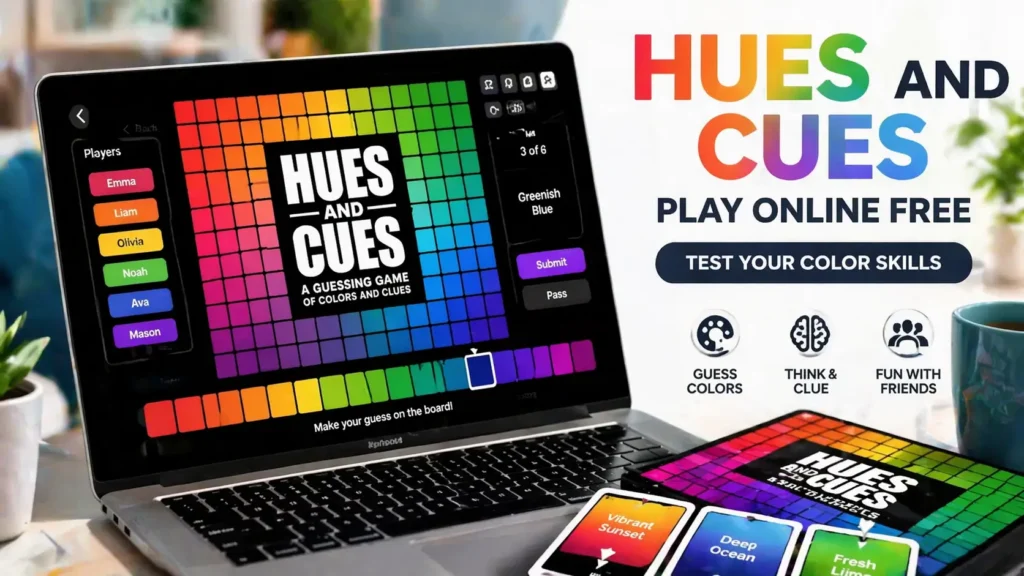
Table of Contents
Why Hues and Cues works so well online
Online tools can add convenience when a group already has access to a suitable third-party version. People may join from different places and keep the experience social. Hues and Cues also fit online play because the screen naturally displays colors cleanly and visually. Players can focus on the clue, scan the grid, and make a decision without too much delay.
Online play is also useful for practice. You can play more rounds in less time, notice patterns in your own choices, and learn how different clues connect to color families. That makes it feel natural instead of forced.
How to Play Hues and Cues Online With Confidence
The basic goal is simple. One player knows the target shade and gives a clue. The other players try to guess which color on the grid matches that clue best. In Hues and Cues, the challenge is not only naming a color but also understanding how others interpret your words.
A normal round usually works like this:
- One player receives a hidden target color.
- That player gives a one-word clue first.
- Other players place guesses on the color grid.
- If the guesses are not close enough, the clue giver adds a second clue.
- Players adjust their choices based on the extra hint.
- Points are earned depending on how close the guesses are.
This structure creates tension in a fun way. A clue must be helpful, but not too obvious. Players must think carefully, but not too slowly. Because of that balance, the game feels lively from start to finish.
A simple example for beginners
Imagine the hidden shade is a warm yellow-orange. The clue giver might say “mango.” One player may think of a strong orange. Another may picture a softer golden tone. After the second clue, perhaps “ripe,” players narrow their guesses and move closer to the intended area.
That example shows why the game is more than basic color matching. It also tests communication, imagination, and shared understanding.
Tips for giving better clues
Good clues are usually clear, familiar, and strongly connected to daily life. Try these ideas:
- Use objects people know well, like a lemon, rose, sky, peach, or charcoal.
- Think about how the group understands common color words.
- Avoid clues that are too broad, such as nice or bright.
- Do not rush your first clue if a more precise word comes to mind.
- Use the second clue to guide players, not to confuse them.
A strong clue often comes from real things people can picture quickly. That is why food, nature, clothing, weather, and home items work so well.
Skills You Can Build by Playing Hues and Cues
Many players start because the game looks fun, but they stay because it sharpens useful mental skills. Hues and Cues encourages players to notice small differences, describe ideas clearly, and understand how others think.
Here are some of the main skills the game can help develop.
Color recognition
This is the most obvious skill, but it matters a lot. The more you play, the more easily you notice soft changes in shade, warmth, depth, and brightness. You begin to see the difference between dusty pink and coral, teal and turquoise, olive and lime.
Visual attention
Because the board contains many close shades, players must scan carefully and avoid careless choices. That improves attention to detail. Over time, you may become better at spotting subtle visual differences not only in games but also in design, art, fashion, and everyday objects.
Word choice and communication
The game pushes players to choose words with purpose. A vague clue can send everyone in the wrong direction. A well-chosen clue can lead the group close to the right answer. This makes Hues and Cues a fun way to practice saying more with fewer words.
Social awareness
Success often depends on knowing your group. A clue that works well with artists may not work the same way with children or casual players. Good clue givers learn how their audience thinks. That social reading skill makes the game feel smart and interactive.
Flexible thinking
Sometimes your first idea fails. When that happens, you need to adjust quickly. You must think of a better angle, a clearer example, or a more familiar word. That habit of adapting under light pressure is useful in many other situations, too.
Here is a simple table that shows the link between game actions and real benefits:
| Game element | What players do | Skill it supports |
|---|---|---|
| Hues and Cues board scanning | Compare similar shades | Visual focus |
| One word clue | Pick the clearest idea | Word precision |
| Second clue | Refine the message | Flexible thinking |
| Guessing with others | Predict how people interpret clues | Social awareness |
| Repeated rounds | Notice shade patterns faster | Color recognition |
Best Ways to Enjoy Hues and Cues With Friends and Family
One of the biggest strengths of Hues and Cues is how easily it fits different situations. You can treat it as a party game, a family activity, a classroom exercise, or a relaxed online session with friends.
To make the experience better, set the mood before starting. Keep the tone light. Let new players learn without pressure. Encourage creative clues, but make sure everyone understands the core rules.
Great ways to use the game in real life
- Add Hues and Cues to family game night for a fun change from standard board games.
- Use it in online hangouts when you want something more creative than simple chat.
- Try it in classrooms to support color vocabulary and descriptive thinking.
- Play short rounds during team-building sessions to create light social energy.
- Use it as a warm-up game before longer party activities.
How to make sessions more fun
A few smart choices can improve the whole experience:
- Keep group size balanced so turns move at a good pace.
- Make sure players can see the screen clearly.
- Encourage clues based on shared experiences.
- Let beginners watch one round before joining.
- Celebrate close guesses, not only perfect ones.
This game is often funniest when players explain why they chose a certain shade. Those short discussions reveal how differently people connect words and colors. That is where much of the charm comes from.
Common Mistakes New Hues and Cues Players Make
Like many simple games, this one looks easy at first. But beginners often make small mistakes that reduce their score or confuse the group. Learning to avoid them can help you enjoy Hues and Cues more from the start.
Giving clues that are too wide
Words like pretty, deep, clean, or soft may sound useful, but they often point to too many shades. A clue should narrow the field, not expand it.
Ignoring the group’s point of view
A clue may make perfect sense in your own mind, but the real question is whether others will interpret it the same way. Strong players think about shared understanding, not just personal meaning.
Overthinking every guess
Some players spend too long trying to find the perfect square. That can slow the pace and remove the easy fun that makes the game special. A thoughtful guess is good. A frozen guess is not.
Forgetting brightness and tone
New players often focus only on the basic color family. They think blue, green, red, or yellow, but they forget softness, darkness, and warmth. Those details matter a lot.
Missing helpful patterns
With practice, you start to notice that certain words usually land in similar zones. Food clues, weather clues, and nature clues often create patterns. Paying attention to those trends can improve your decisions.
Hues and Cues Compared With Other Color and Party Games
There are many party games and creative guessing games available today, but Hues and Cues has a special place because it combines visual skill with communication in such a clean way. It does not depend on drawing talent, trivia knowledge, or fast physical reactions. Instead, it rewards observation and smart wording.
That makes it easier for a wide range of players to enjoy. Some games favor loud personalities or quick reflexes. This one gives quiet, thoughtful players a fair chance to shine.
Here is a simple comparison:
| Feature | This game | Trivia games | Drawing games | Word party games |
|---|---|---|---|---|
| Main skill | Color judgment | General knowledge | Sketching ideas | Vocabulary speed |
| Easy for beginners | Yes | Sometimes | Depends on confidence | Usually |
| Fast to learn | Yes | Yes | Yes | Yes |
| Visual challenge | Strong | Low | Medium | Low |
| Social discussion | Strong | Medium | Strong | Strong |
If you enjoy games that feel relaxed but still mentally engaging, this type of experience is an excellent fit. It works especially well for players who like visual thinking and subtle challenges instead of loud competition.
Try a Spectrum Guessing Game Online Too
If your group enjoys Hues and Cues, Wavelength offers a similar guessing challenge built around word spectrums instead of colours. Our free online rooms let friends join from their own phones with a room code, while the game rotates the clue giver automatically, keeps score, and runs smoothly in any modern browser. Play Wavelength online free.
FAQs About Hues and Cues
Is Hues and Cues easy for beginners to learn?
Yes, the rules are simple, and most people understand the main idea after one round. The challenge grows naturally as players learn how clues connect to shades.
Can I play Hues and Cues online with friends?
Yes, online play works very well because everyone can view the color grid clearly and respond quickly. It is a great option for remote game nights and casual group sessions.
Does Hues and Cues help improve color skills?
Yes, regular play can sharpen shade recognition, visual focus, and descriptive language. Many players notice that they become more confident when comparing similar colors.
What type of clues work best in this game?
The best clues are clear, familiar, and easy to picture. Everyday objects, food, flowers, weather, and clothing colors usually help players make better guesses.
Is this game good for families, parties, and classrooms?
Yes, it suits many settings because the rules are simple and the tone stays light. It can be enjoyed by children, adults, friends, and groups that want a creative and social activity.
Can I play a similar spectrum game online here?
Yes. Wavelength uses a similar idea of guiding teammates toward a hidden target, and our free online rooms let friends play it together from their own phones with a simple room code.